What a digital twin gives a building: informed decisions from design to operation
Listen to key points0:50
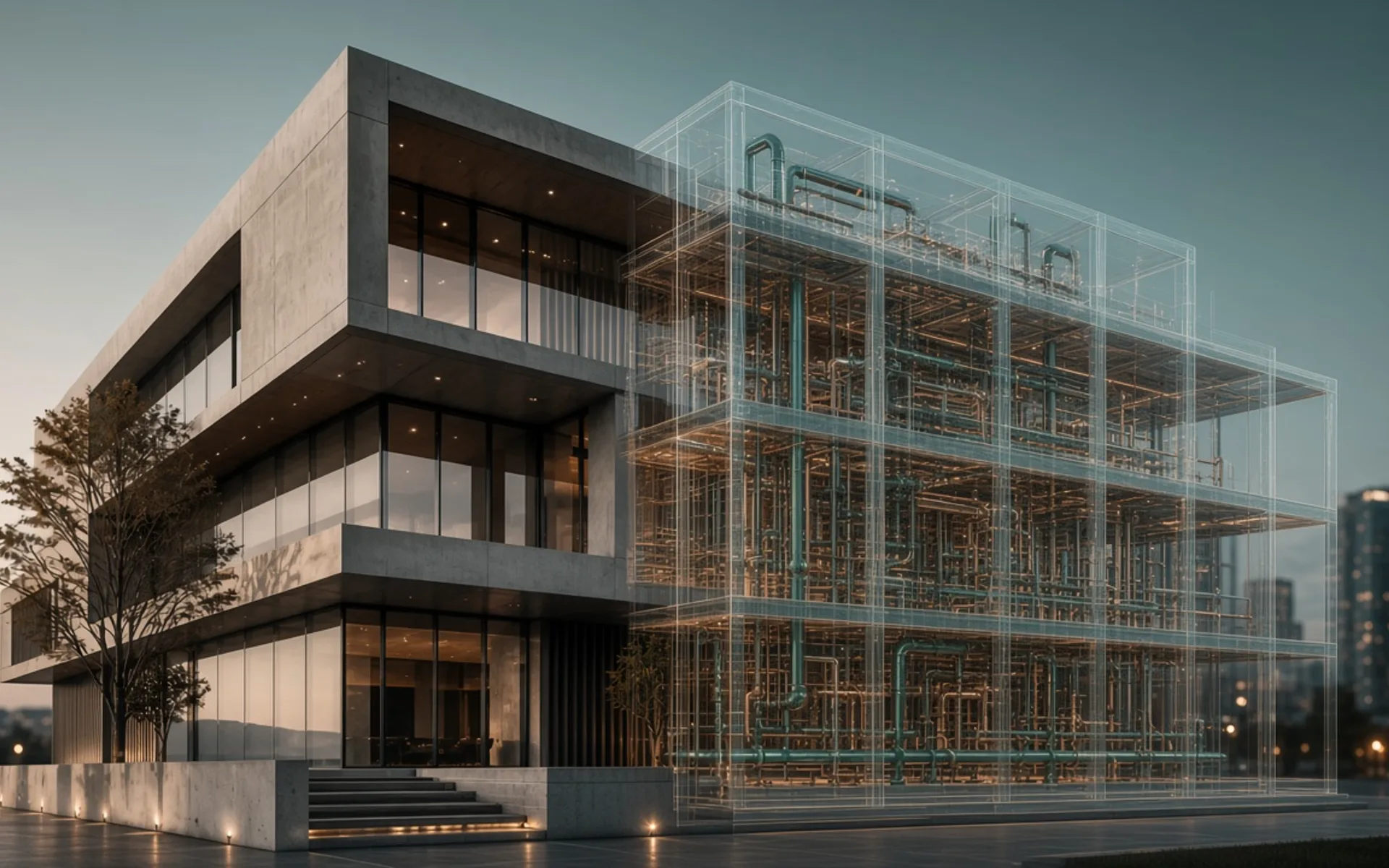
When construction finishes, only the longest part of a building's story begins. Most of a building's life is spent in operation, where decisions are often made on scattered documents, personal memory and unanswered questions. A digital twin is one approach that tries to close that gap. This article looks at how it differs from a design model, what it can offer during operation, and what the realistic limits are.
A digital model after handover During design, a BIM model is built to coordinate architectural, structural and engineering decisions. After handover that model is often archived or drifts away from reality, because changes made during construction are not fed back into it. A digital twin approach aims to keep the information alive: the model reflects the building as built, documents and equipment data are linked to it, and in some cases it is connected to data from sensors or building management systems.
The core difference is this: a design model answers “what will we build?”, while a digital twin tries to help answer “how is the building behaving now, and what can we do about it?”
Maintenance and technical services In maintenance decisions, the place where most time is lost is searching for information: where a piece of equipment is installed, what its warranty period is, which system serves which zone, which material was used. If that information is tied to the model or to a database linked to the model, the facilities team can orient itself faster.
Possible practical benefits:
- finding the equipment register, service history and manuals in their spatial context;
- better-informed budgeting for planned maintenance and replacement;
- knowing in advance where concealed services run during refurbishment or repair;
- clearer tracking of recurring faults or service demands.
These benefits depend on keeping the model and its data current. Without a responsible person and a clear update routine, a model becomes outdated quickly.
Energy and comfort Energy use, ventilation and temperature conditions are an important part of operating cost. When metering data is linked to the model, the team can see patterns by zone, system and usage mode more clearly: which zone uses more energy than expected, which system operates outside design assumptions.
The aim is not to promise “magic” savings. It is to base decisions on better information: what to tune, what to repair, what to consider in the next refurbishment. The real outcome depends on building type, the quality of the systems and the operations team's ability to work with the data.
Operational visibility In multi-site or multi-storey facilities, the management team often works with separate reports from different systems. A digital twin approach can help bring that information into a single spatial context: an event, alert or work order is tied to a specific place and system in the building.
This is especially useful when:
- several buildings or a large campus are managed;
- service teams and contractors change frequently;
- institutional memory about the building depends on a few individuals;
- an investor or owner needs more transparent reporting on building condition.
Realistic limits Expectations around digital twins can run very high, and it is important to temper them professionally.
- **Data quality.** A model is only as good as the data entered. Changes made during construction, an imprecise as-built model or incomplete equipment data greatly reduce its value.
- **Ongoing cost.** Updating the model, integrating systems and maintaining software take continuing resources. That cost should be included in the operating budget in advance.
- **Integration complexity.** Building management systems, sensors and other software can work in different formats. Integration can be technically and organisationally difficult.
- **Team readiness.** If the operations team is not ready to work with data, even the best model stays unused.
- **Security and data governance.** Digital information about a building can be sensitive: who can see what, and where the data is stored, should be decided in advance.
- **Not right for every building.** For small and simple facilities, the cost of a full digital twin can be hard to justify; sometimes a well-organised digital archive and handover documentation are enough.
It all starts at design stage To get a useful digital twin after handover, decisions must be made early. Key points for the client:
- operational goals and data requirements (for example, which equipment data is needed) should be defined at the start of the project;
- delivery of the as-built model and equipment data by contractors should be written into contracts;
- consistent rules for naming and data structure should be applied;
- the model should be verified against the real building at handover.
These requirements cost relatively little to address during design, but can be considerably more expensive and difficult to reconstruct later.
A step-by-step approach Not every project needs to start with a fully functional digital twin. A practical path can be staged:
1. Start with an accurate as-built model and equipment register. 2. Link the maintenance and work-order system to the model. 3. Integrate energy or comfort metering for selected zones. 4. Expand the scope after evaluating the results.
At each step, a concrete question should be asked: which decision will this data improve, and who will use it?